
SUST is known for its animal welfare projects in Switzerland and many other countries. This page shows what goes into these projects: how decisions are made, how quality is ensured on site, and who monitors the funding.
The mission describes what the foundation is working on today. The vision describes the state that this work should lead to.
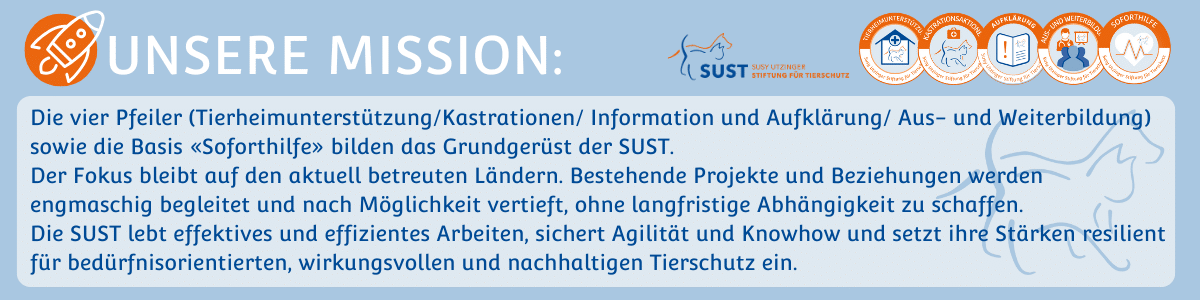
The four pillars – animal shelter support, castration, information and education, and training and further education – and the basic “immediate aid” form the foundation of SUST.
The focus remains on the countries currently being supported. Existing projects and relationships will be closely monitored and, where possible, strengthened without creating long-term dependencies.
SUST practices effective and efficient work, ensures agility and know-how, and resiliently uses its strengths for needs-oriented, effective, and sustainable animal welfare.
Everyone has access to information and means to treat and keep animals in a species-appropriate manner and to make their consumption free from animal suffering.
Humanity consciously applies this knowledge and takes responsibility for its actions. Animal welfare is not a necessity, but a matter of course.
In animal welfare, speed often determines whether help is still effective. The foundation is structured accordingly.
SUST develops and operates its projects itself. This focus allows it to use resources where they directly impact the lives of animals and to adapt its work to local needs.
The organization has a flat structure. This keeps the foundation agile and allows animal welfare professionals to react quickly to new developments and urgent needs.
Rapid intervention can be lifesaving in animal welfare. Therefore, communication channels are short and decisions are made promptly so that animals in distress can be helped.
The foundation uses a modest infrastructure adapted to its animal welfare work. Virtually no budget is available for advertising and marketing.
Most of this work doesn't take place in Turbenthal, but in animal shelters, clinics, and on the streets. To ensure that the promised aid reaches those who need it, the SUST operates according to these principles.

SUST is an independent, non-profit animal welfare foundation. It finances all its animal welfare activities through donations and bequests and receives no public funding.
The foundation does not belong to any umbrella organization or other association. It decides for itself where it provides aid.
The annual accounts and activity report are audited annually by the Federal Department of Home Affairs as part of its statutory supervisory duties (Art. 84 para. 2 of the Swiss Civil Code).
The foundation receives no public funding. It is tax-exempt; donations may be tax-deductible depending on cantonal tax law.
Animal welfare projects only take effect over several years. SUST budgets accordingly carefully and ensures a sustainable financial basis so that ongoing projects can be sustained in the long term.
The management of the foundation is not left to individual discretion. Since 2010, a written code has defined how the foundation board and management operate and where responsibilities lie.
The code serves the efficient and long-term realization of the foundation's purpose. It defines the responsibilities of the board of trustees and the management in more detail and ensures clear leadership structures. The foundation also adheres to the Swiss Foundation Code.

This Good Governance Code serves the efficient and long-term realization of the purpose of the Susy Utzinger Foundation for Animal Welfare. It defines the responsibilities of the Board of Trustees and the management in more detail and ensures clear leadership structures.
I. Responsibilities and tasks (Articles 5 and 6 of the SUST Foundation Charter)
a) The Board of Trustees is the strategic management body and performs medium- and long-term management and control functions. The Board of Trustees bears overall responsibility for the foundation, in particular for its business operations, the administration and use of foundation funds, risk management, and effective controlling.
b) In addition to the tasks described in Articles 5 and 6 of the foundation charter, the foundation board is responsible in particular for the following:
c) Tasks not expressly assigned to the management or another body fall within the remit of the board of trustees. In case of doubt, the board decides on the allocation of a task.
d) While maintaining its oversight and responsibility, the Board of Trustees may delegate tasks to the management.
II. Working Method
a) The Board of Trustees shall establish appropriate structures and procedures for the fulfillment of its tasks.
b) The Board of Trustees determines the number of annual meetings. The President may convene extraordinary meetings as needed.
c) The Board of Trustees ensures standardized information flows between its members and the office. It regulates external representation and representation vis-à-vis banks and the postal service.
III. Avoiding conflicts of interest between the board of trustees and the management
a) The members of the board of trustees and the management ensure that conflicts of interest are avoided.
b) If the interests of the foundation conflict with the interests of members of the board of trustees or the management, or persons closely associated with them, these conflicts will be disclosed to the board of trustees. In this case, the member in question will recuse themselves.
c) Legal transactions of the foundation with, and in particular orders to, members of the foundation board, shall be concluded under the same conditions as with third parties and disclosed within the foundation board.
IV. Assignment of special tasks
a) The Board of Trustees may delegate tasks requiring special expertise or experience within the scope of the foundation's purpose to one or more members of the Board of Trustees within the framework of project-related special tasks.
b) The Board of Trustees decides on the delegation of specific tasks to individual members and regulates the content, requirements, and conditions in writing. The delegation of specific tasks must be limited in time.
c) The transfer of special tasks must not be compensated at a higher rate than is customary in the industry.
V. Compensation
a) Subject to specifically identified expenses, the members of the Board of Trustees generally provide their services free of charge. No presidential allowance is paid. The legal representation of the Foundation in any civil, administrative, and criminal proceedings is handled by trusted lawyers outside the Board of Trustees.
b) If, in exceptional cases, compensation is paid, the following principles apply:
VI. Presidium
a) The President (the Presidium) chairs the Board of Trustees.
b) It chairs its meetings and ensures efficient working methods. In particular, it guarantees long-term planning in terms of time and content (agenda-setting) and the proper procedures for preparing and conducting the meeting.
c) It ensures confidentiality within the foundation board to guarantee open discussion.
d) It monitors and promotes the implementation of the foundation board's decisions by the management.
VII. Cooperation between the Board of Trustees and the Management
a) The management supports the board of trustees in its decision-making and implements its decisions.
b) The management prepares the business of the board of trustees and implements its decisions. It thinks and acts proactively and contributes ideas and suggestions.
c) It ensures that the board of trustees is informed in a timely and comprehensive manner about matters relevant to its tasks.
d) The management usually participates in the foundation board meetings in an advisory capacity.
a) The management conducts the office and the operational business efficiently and effectively with regard to the foundation's objectives.
b) It sets and implements the priorities for achieving the specified objectives within the framework of the guidelines of the Board of Trustees.
c) Members of the management shall inform the board of trustees in advance of any appointments of persons close to them or of any commissions given to such persons.
d) The members of the management board shall ensure appropriate further development of their own management and professional skills and those of the employees and regular representatives of the foundation.
a) The Board of Trustees shall ensure an adequate internal control system and risk management.
b) The Board of Trustees, together with the management, is responsible for transparent communication that is targeted to specific groups and in a timely manner.
Kollbrunn, February 23, 2010
Those who want to take a closer look will find the names, the invoice, and the projects in these three places.
Information about the foundation, board of trustees, advisory board and management – including names and functions.
Regarding the organizationWhat happened in one year, what it achieved, and how the funds were used. Available as a downloadable PDF.
Regarding the reportsThe four pillars of animal welfare work and immediate aid as a basis – what the foundation is actually for.
Purpose of the foundationThe donors and patrons of SUST are a valuable support, earned through trust. Without them, neither the projects nor the structures described on this page would exist.

Pay securely with card, TWINT or PostFinance.
For example: In Egypt, CHF 20 will be used to neuter and provide medical care for a cat.
For example: With CHF 50 you can fill five food bowls for animals in need.
For example: In Romania, CHF 150 will be used to neuter and provide medical care for six cats.
You choose the amount yourself in the next step.
For example: With CHF 10 a month you can fill a food bowl for animals in need every month.
For example: With CHF 25 per month, a cat in Romania will be neutered and given medical care every month.
For example: CHF 50 per month can fund 30 castrations in Egypt in one year.
You choose the monthly amount yourself in the next step, starting from CHF 5.
You can cancel the monthly donation at any time with one month's notice.
Prefer a fee-free donation? Donations can be made to account IBAN CH87 0900 0000 8466 6666 9 (PostFinance), Susy Utzinger Foundation for Animal Welfare, 8488 Turbenthal. The foundation is tax-exempt; donations of CHF 100 or more will be acknowledged with a personal letter.






You are currently viewing placeholder content from reCAPTCHA . To access the actual content, click the button below. Please note that this will involve sharing data with third parties.
More information